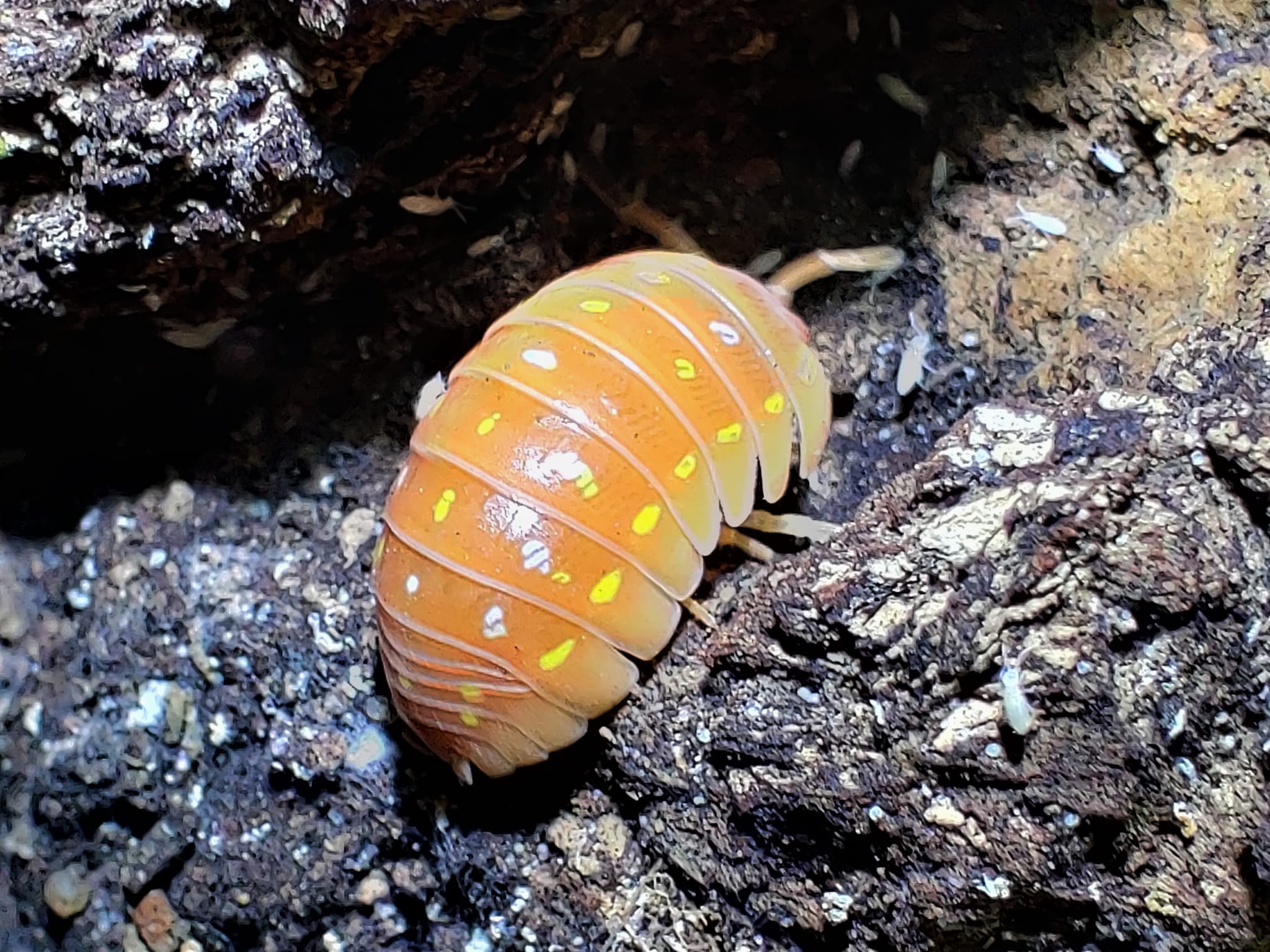
Armadillidium frontetriangulum ‘Corfu Orange’
This is a temp holding page and will need to be updated – Do you fancy doing the write up for this species, if so please contact Mark.r.goodwin@gmail.com
Armadillidium frontetriangulum (Corfu Orange Isopod) The Corfu Orange Isopod is a striking crustacean that exhibits distinctive morphological traits. It typically measures between 1 to 3 cm in length and is characterized by its robust, oval body shape that enables it to roll into a ball – a defensive mechanism common among pillbugs and roly-polies.
| Common Name | Corfu Orange Isopod |
|---|---|
| Scientific Name | Armadillidium frontetriangulum ‘Corfu Orange’ |
| Taxonomy |
|
| Habitat | The Armodillidium frontetriangulum thrives in humid, temperate environments. It is typically found in leaf litter, under rocks, and in decaying wood, where it plays a vital role in the ecosystem by aiding in the decomposition of organic materials. |
| Region | The Armodillidium frontetriangulum is endemic to the island of Corfu in Greece |
| Lifespan (Years) | 2 |
| Diet | Decaying plant matter, leaf litter, calcium supplement, occasional protein |
| Humidity Range (%) | 60–90 |
| Temperature Range (°C) | |
| Conservation Status | While specific conservation statuses for the Corfu Orange Isopod are not well-documented, maintaining the integrity of its natural habitat is vital for its survival. Habitat destruction through urban development and pollution poses threats to this and similar endemic species on the island. |
| Coloration | The most notable feature of this species is its vibrant orange coloration, which can vary in intensity from a soft peach hue to a deep, rich orange. This bright coloration is often accented by darker bands or spots, giving it a mottled appearance that helps it camouflage among the leaf litter and substrate in its natural habitat. |
| Care Notes | Provide moist substrate with hiding spots. Use leaf litter, decayed wood, and moss. Ensure moderate to high humidity with ventilation. |
| Breeding Info | Isopods generally reproduce through eggs, which the females carry in a brood pouch called a marsupium. The gestation period varies depending on environmental conditions, but typically, young are released as miniature versions of adults after several weeks. |
| Adult Size (cm) | 1.5 |
| Temperament | Shy to docile, species dependent |
Was this helpful?
1 / 0